
Places > Florence
Villa Il Gioiello
Florence, Arcetri, via del Pian dei Giullari
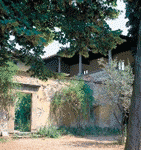
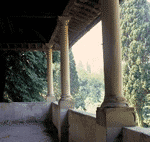
The
villa, which seems to date from the 14th century, was rebuilt in the 16th. The
name "Gioiello" (jewel) referred to the the property's attractive location, on
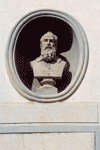
the hills of Arcetri looking to the west. In memory of Galileo Galilei, who
spent the last years of his life there, the facade bears a bust dating from
1843 and two memorial stones (1788 and 1942).
It
was Galileo's daughter Virginia who informed her father, in August 1631, of the
possibility of renting the villa adjoining the Convent of San Matteo in Arcetri
(both of Galileo's daughters had become nuns in this convent: Virginia in
October 1616 under the name of Suor Maria Celeste, Livia in October 1617 under
that of Suor Arcangela.). Galileo signed the lease in September 1631. As
reported by his biographer Niccolò Gherardini, Galileo "remained for many hours
at a time in his little garden, and all of those pergolas and fish ponds he
wished to arrange with his own hand,
with such symmetry and proportions that it was a thing worthy to be seen."
After
his condemnation by the Court of the Holy Office, Galileo was given hospitality
in Siena by Archbishop Ascanio Piccolomini, since it would have been imprudent
for him to go on to Florence, where the plague was still raging. On December 1, 1633 the Congregation of the Holy
Office granted the scientist permission to return to the "Gioiello", but forbid
him to receive persons with whom he could discuss any scientific subjects.
During the last days of the year he received a visit from the Grand Duke of
Tuscany Ferdinando II de' Medici. Only in January 1639 was he allowed, due to
his poor health, to host the young Vincenzo Viviani, and then, three months
before his death, Evangelista Torricelli as well.
Here
Galileo ended his days, assisted by his son Vincenzo, and by Torricelli and
Viviani. The latter, in his Racconto
istorico della vita di Galileo [Historical
Account of Galileo's Life] (1654), described the master's last moments in
these words: "Overcome by long fever and palpitations of the heart, after two
months of illness that little by little consumed his spirits, on Wednesday the
8th of January of the year 1641 ab
Incarnatione [1642], at the fourth hour of the night, aged seventy-seven
years, ten months and twenty days, with philosophy and Christian constancy he
rendered his soul to his Creator, this soul being sent, as we may be
glad to believe,
to enjoy and admire again more closely those eternal and immutable marvels
that, by means of fragile artifice, with such great avidity and impatience it
had managed to bring closer to the eyes of us mortals."